
“Nrima”: A Javanese Cultural Value and Its Influence on Healthcare
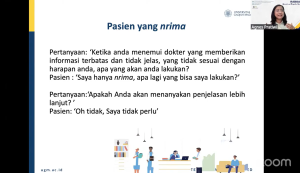
Center for Bioethics and Medical Humanities (CBMH), Universitas Gadjah Mada, once again held its weekly routine program, Raboan Research and Perspective Sharing, on Wednesday, 30 July 2025. Conducted online via Zoom Meeting, the session addressed a highly relevant topic entitled “Nrima – a Particular Javanese Value and Its Impact on Healthcare.”
The event featured drg. Agnes Bhakti Pratiwi, MPH, Ph.D., a faculty member of FK-KMK UGM, as the main speaker, and was moderated by Ardhini Nugrahaeni, M.K.M.
The concept of nrima, which refers to sincere acceptance of one’s circumstances, including illness, is deeply rooted in Javanese society. This value reflects resilience, patience, and an adaptive capacity to face life’s challenges. In the healthcare context, nrima may encourage patients to remain steadfast and compliant during long-term treatment, while also supporting their mental well-being when dealing with chronic or irreversible conditions.
However, the discussion also highlighted the ethical challenges associated with nrima, particularly in relation to patient autonomy and doctor–patient communication. Patients who strongly adhere to nrima tend to be passive, less likely to fully express their symptoms, and reluctant to ask for further medical information. Consequently, healthcare providers may offer limited explanations, potentially reducing the quality and completeness of medical information received by patients.
“In the context of SDG 3: Good Health and Well-Being, it is crucial for healthcare systems not only to understand local cultural values such as nrima, but also to balance them with the fulfillment of patients’ rights,” stated drg. Agnes. She further emphasized, “Without culturally sensitive communication approaches, we may unintentionally diminish patient autonomy and weaken their participation in medical decision-making.”
Moreover, this phenomenon is closely related to SDG 10: Reduced Inequalities. Patients from certain cultural backgrounds, including Javanese communities that uphold nrima, face a higher risk of unequal access to comprehensive medical information and equitable involvement in healthcare decisions.
As potential solutions, drg. Agnes recommended strengthening education on patients’ rights, providing culturally sensitive communication training for healthcare professionals, and empowering patients to feel more confident in asking questions and expressing their needs. Through these efforts, healthcare services can become more inclusive, equitable, and effective.
This discussion represents an important contribution to CBMH’s ongoing commitment to promoting a locally rooted, globally respected approach—integrating local cultural values into the national healthcare system while upholding universal ethical principles.
Reporter: Ardhini Nugrahaeni, M.K.M
Editor: Rafi