
Academic Excellence, but Where Is Empathy? Rethinking Medical School Admissions
Yogyakarta, 6 August 2025 — The quality of a nation’s healthcare system is strongly determined by the quality of its medical workforce, particularly physicians who stand at the frontline of healthcare delivery. Behind every competent doctor lies a selection process that determines who is granted the opportunity to pursue medical education. Amid the growing demand for healthcare professionals who possess not only academic excellence but also strong integrity and empathy, a fundamental question arises: does the current medical school admissions system in Indonesia adequately respond to the needs of today’s healthcare landscape?
This strategic issue became the focus of the Raboan Discussion Forum, held on Wednesday, 6 August 2025, under the theme “Medical School Admissions: Are We on the Right Track?” The forum featured dr. Hikmah Muktamiroh, MMedEd, SpKKLP, Subsp COPC, who delivered a comprehensive overview of the dynamics of medical student selection in Indonesia, compared it with practices in developed countries, and proposed innovative pathways for reform.
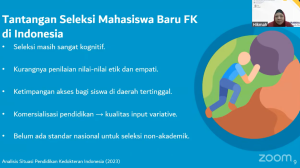
In her presentation, dr. Hikmah emphasized that medical school admissions in Indonesia remain heavily focused on cognitive and academic performance, with insufficient assessment of ethical values and empathy. This imbalance risks producing graduates who excel academically but may lack adequate readiness to navigate the complex human relationships inherent in clinical practice.
She also highlighted several critical challenges, including unequal access for students from 3T regions (Tertinggal, Terdepan, and Terluar – underdeveloped, frontier, and remote areas), the commercialization of medical education, and the absence of a national standard for non-academic assessment. As a comparison, dr. Hikmah discussed admission practices in countries such as the United States, the United Kingdom, and Canada, where selection processes have incorporated Multiple Mini Interviews (MMI), personality assessments, and evaluations of empathy and communication skills.
Towards the end of the session, several policy reform proposals were presented, including strengthening soft skills assessment, providing affirmative pathways for students from 3T regions, enhancing training for faculty interviewers, and involving professional organizations as well as bioethics experts in designing a fairer and future-oriented admissions system.
This topic is highly relevant within the framework of the Sustainable Development Goals (SDGs), particularly SDG 3: Good Health and Well-Being, SDG 4: Quality Education, and SDG 10: Reduced Inequalities. Reforming medical education admissions to be more inclusive, ethical, and equitable is a crucial foundation for ensuring that all citizens—without exception—have access to high-quality healthcare delivered by competent and principled medical professionals.
Reporter: Rafi
Editor: Alvira





Leave a Reply
Want to join the discussion?Feel free to contribute!