
Rapid Advances in Medical Technology and Emerging Ethical Dilemmas
Rapid developments in medical technology have brought forward innovations that promise improved quality, efficiency, and accessibility of health care services. At the same time, these advances raise fundamental ethical questions: to what extent should technology be applied in medical practice, how can patient safety and dignity be safeguarded, and who bears responsibility when innovation outpaces ethical reflection and regulation. These critical issues formed the starting point of the RABOAN (Research and Perspective Sharing) forum.
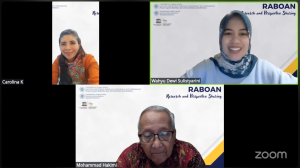
The RABOAN session held on Wednesday, 28 January 2026, was organized by the Center for Bioethics and Medical Humanities (CBMH), Faculty of Medicine, Public Health, and Nursing (FKKMK), Universitas Gadjah Mada, in collaboration with the Master’s Program in Bioethics, Universitas Gadjah Mada. The discussion addressed the theme “Medical Technology: Ethics and Challenges” and featured Dr. dr. Carolina Kuntardjo, SpB., FINACS, S.H., M.H., a surgeon with extensive expertise in health law and medical ethics, as the main speaker. The session was moderated by NS Wahyu Dewi Sulistyarini, M.S.N.
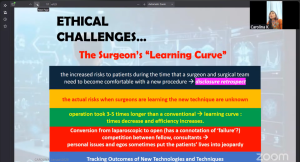
In her presentation, Dr. Carolina emphasized that advances in medical technology cannot be separated from ethical responsibility and professional integrity. Technologies such as artificial intelligence, health information systems, robotic surgery, and telemedicine are designed to enhance health care delivery. However, without adequate ethical understanding and competence, these technologies may generate new risks for patients, health professionals, and health institutions.
A key point highlighted during the discussion was the importance of strengthening ethics education for health professionals. Dr. Carolina noted that while many young practitioners are highly familiar with new technologies, they are often insufficiently equipped with ethical frameworks to guide their use in clinical practice. Senior health professionals therefore play a crucial role in transmitting ethical values and professionalism to the next generation, ensuring that technological progress does not compromise patient safety or human dignity.
The discussion also addressed issues of patient data privacy and confidentiality in the digital era. The digitalization of medical records, the use of health applications, and collaboration with third parties increase the risk of data breaches and legal consequences. Patient data, as emphasized in the forum, constitute a fundamental patient right and must be protected through secure, authorized systems that comply with ethical standards and existing regulations.
In relation to telemedicine and telehealth services, participants were reminded that remote care has clear limitations and cannot fully replace physical examinations. Telemedicine remains subject to ethical and legal accountability, requiring clear regulatory frameworks and enhanced capacity-building for health professionals to ensure safe and high-quality care.
The forum further discussed challenges to medical professionalism in the context of social media and the promotion of health services. Health information shared with the public must be evidence-based, proportional, and ethically responsible. Excessive promotion, misleading testimonials, or practices that undermine professional peers were identified as ethical, disciplinary, and legal violations that risk eroding public trust in the medical profession.
In closing, Dr. Carolina reaffirmed that ethics lie at the core of professional competence in medicine. Not everything that is technically possible can be ethically justified. The doctor–patient relationship must remain central to medical practice, and all technological innovations should ultimately serve to protect patient safety, promote well-being, and uphold human dignity.
Through this RABOAN session, CBMH FKKMK UGM and the Master’s Program in Bioethics UGM reaffirm their commitment to advancing ethical reflection on health technologies. Such discussions are closely aligned with the Sustainable Development Goals (SDGs), particularly SDG 3 (Good Health and Well-being), SDG 16 (Peace, Justice, and Strong Institutions), and the promotion of responsible and equitable innovation. By placing ethics at the foundation of technological development, medical innovation can meaningfully contribute to sustainable, trustworthy, and patient-centered health systems.
—
About RABOAN
RABOAN (Research and Perspective Sharing) is a regular discussion forum organized by CBMH FKKMK UGM in collaboration with the Master’s Program in Bioethics UGM, providing a multidisciplinary space for critical reflection on bioethical issues across diverse fields.
Editor: Rafi




Leave a Reply
Want to join the discussion?Feel free to contribute!