Tag Archive for: Raboan Discussion Forum

Building Patient Safety Through Effective Communication in Healthcare Services

komunikasi failure

Yogyakarta, 15 October 2025 — Communication is a fundamental pillar of healthcare services. In clinical practice, clinics, and hospitals, the quality of interactions between healthcare professionals, patients, and their families often determines the outcomes of care. Yet, communication is also one of the most frequently overlooked sources of risk. Communication failure can lead to misunderstandings, delays in treatment, and even fatal medical incidents.

Recognizing the urgency of this issue, the Center for Bioethics and Medical Humanities (CBMH), Universitas Gadjah Mada, once again organized its weekly Raboan Research and Perspective Sharing on Wednesday, 15 October 2025. Conducted online via Zoom Meeting, the session carried the theme “Communication Failure” and featured dr. Rukmono Siswishanto, M.Kes., SpOG(K) as the main speaker.

In his presentation, dr. Rukmono emphasized that communication lies at the heart of healthcare delivery, as all processes—from consultation and decision-making to medical interventions—depend on accurate information exchange. However, evidence shows that communication failure is a leading cause of sentinel events, defined as unexpected incidents that result in serious patient injury or death.

Communication failures may arise from multiple factors, including unclear message content, misunderstanding of the audience, inappropriate timing, or misaligned communication objectives. Misunderstandings often stem from differences in perspectives, language, and background among those involved. Additional barriers such as assumptions, emotional responses, stress, and fatigue further hinder the effective delivery and reception of information.

Medical consultation was highlighted as the core communication process in healthcare services. Beyond information transfer, consultations must uphold key ethical principles, including beneficence (prioritizing patient well-being), respect for autonomy (honoring patients’ rights to be informed and to make decisions), justice (ensuring fair access to care), and truth-telling (transparency regarding information and conflicts of interest).

International data indicate that the number of sentinel events continues to increase annually. Many of these incidents involve delayed treatment, wrong-site surgery, retained foreign objects after procedures, and patient suicide—most of which could be prevented through effective and systematic communication among healthcare professionals.

According to dr. Rukmono, the most common forms of communication failure include insufficient or untimely information provided to patients, lack of information sharing among colleagues, poor listening skills, and failure to involve family members or caregivers in decision-making processes. Contributing factors range from individual conditions of healthcare workers and heavy workloads to unstructured communication systems and weak interprofessional collaboration.

As solutions, healthcare professionals are encouraged to improve communication at both personal and systemic levels. Recommended measures include strengthening empathy, managing stress, improving medical documentation, refining team communication workflows, and understanding patients’ backgrounds and needs. Structured communication approaches such as SBAR (Situation–Background–Assessment–Recommendation), read-back, and team briefings were recommended to minimize errors and clarify instructions.

At the conclusion of the session, dr. Rukmono underscored that effective communication is the foundation of patient safety. Improving communication systems must become part of the institutional culture in healthcare settings, and clinical communication training should be integrated from medical education through professional practice.

These efforts align with the Sustainable Development Goals (SDGs), particularly SDG 3: Good Health and Well-Being, which aims to ensure healthy lives and promote well-being for all at all ages. By strengthening communication in healthcare services, medical professionals not only enhance service quality but also contribute meaningfully to the development of a safer, more equitable, and sustainable healthcare system.

Reporter: Ardhini N, M.K.M.
Editor: Rafi
Ethical Dilemmas Behind Neuroenhancement Technology and Brain Modification

BIOETIKA HUMANIORA MEDICAL ETHICS

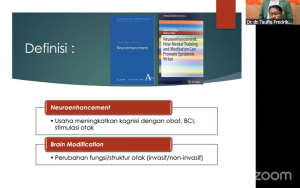
Yogyakarta, 12 September 2025 — Rapid advancements in neuroscience technology over recent years have presented both significant opportunities and profound challenges for the fields of healthcare and education. Innovations such as neuroenhancement—the enhancement of human brain function beyond normal conditions—not only promise new medical solutions but also raise critical questions concerning justice, safety, and ethical use.

In response to the urgency of these issues, the Center for Bioethics and Medical Humanities (CBMH), Faculty of Medicine, Public Health, and Nursing, Universitas Gadjah Mada (FK-KMK UGM), held its weekly RABOAN academic forum on Wednesday, 10 September 2025. This regular forum serves as an interdisciplinary platform for discussing contemporary issues in bioethics.

The theme of this session was “Neuroenhancement and Brain Modification: Ethical Aspects in the Use of Cognitive Enhancement Technologies.” The main speaker, Dr. dr. Taufiq Fredrik Pasiak, M.Kes., M.Pd.I., MH., CIPA, delivered a comprehensive presentation on the development of neuroscience technologies and their accompanying ethical implications. The discussion was moderated by Mahmasoni Masdar, S.Kep., Ns., M.Kep.

During the session, Dr. Taufiq explained that neuroenhancement refers to the use of technology to improve human cognitive brain functions beyond their normal state. Current examples include non-invasive brain stimulation, concentration-enhancing pharmaceuticals, and the potential for brain modification through advanced technological interventions.

According to him, these technological developments offer significant opportunities in education, healthcare, and workplace productivity. For instance, cognitive enhancement technologies may assist patients with neurodegenerative disorders such as Alzheimer’s disease, or support individuals with learning difficulties in adapting more effectively.

Nevertheless, he emphasized that such innovations are inseparable from serious ethical concerns, including:

  • Justice and accessibility — whether these technologies will be accessible only to financially privileged groups, thereby widening existing inequalities.

  • Long-term safety — the lack of extensive research on long-term effects raises concerns about potential new health risks.

  • Privacy and individual freedom — technologies capable of influencing brain function provoke fundamental questions regarding the protection of human rights.

  • The need for regulation — the importance of developing policy frameworks involving multidisciplinary perspectives, from medicine to law, to ensure ethical governance of these technologies.

Dr. Taufiq also highlighted the concept of neurorights, referring to fundamental rights that must be safeguarded in the era of neuroscience innovation. These include the right to personal identity, freedom of thought, mental privacy, and protection against discrimination based on cognitive capacity.

This issue is closely linked to the achievement of the Sustainable Development Goals (SDGs), particularly SDG 3: Good Health and Well-Being. Cognitive enhancement technologies hold potential to support brain health and improve quality of life, especially in the prevention and treatment of neurological and mental disorders. Neuroenhancement may also contribute to the rehabilitation of patients with impaired brain function, enabling them to return to productive daily activities. However, without appropriate regulation, such technologies risk generating new health problems, including dependency, misuse, or unknown long-term effects.

By addressing the topic of neuroenhancement, CBMH UGM demonstrates its commitment to ethical reflection amid rapid technological innovation. It is hoped that this discussion will serve as a starting point for further research, policy development, and regulatory frameworks that can balance technological benefits with the protection of fundamental human values.

Reporter: Ardhini N, M.K.M.
Editor: Rafi
 

Academic Excellence, but Where Is Empathy? Rethinking Medical School Admissions

raboan bioetika

Yogyakarta, 6 August 2025 — The quality of a nation’s healthcare system is strongly determined by the quality of its medical workforce, particularly physicians who stand at the frontline of healthcare delivery. Behind every competent doctor lies a selection process that determines who is granted the opportunity to pursue medical education. Amid the growing demand for healthcare professionals who possess not only academic excellence but also strong integrity and empathy, a fundamental question arises: does the current medical school admissions system in Indonesia adequately respond to the needs of today’s healthcare landscape?

This strategic issue became the focus of the Raboan Discussion Forum, held on Wednesday, 6 August 2025, under the theme “Medical School Admissions: Are We on the Right Track?” The forum featured dr. Hikmah Muktamiroh, MMedEd, SpKKLP, Subsp COPC, who delivered a comprehensive overview of the dynamics of medical student selection in Indonesia, compared it with practices in developed countries, and proposed innovative pathways for reform.

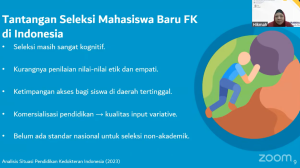
In her presentation, dr. Hikmah emphasized that medical school admissions in Indonesia remain heavily focused on cognitive and academic performance, with insufficient assessment of ethical values and empathy. This imbalance risks producing graduates who excel academically but may lack adequate readiness to navigate the complex human relationships inherent in clinical practice.

She also highlighted several critical challenges, including unequal access for students from 3T regions (Tertinggal, Terdepan, and Terluar – underdeveloped, frontier, and remote areas), the commercialization of medical education, and the absence of a national standard for non-academic assessment. As a comparison, dr. Hikmah discussed admission practices in countries such as the United States, the United Kingdom, and Canada, where selection processes have incorporated Multiple Mini Interviews (MMI), personality assessments, and evaluations of empathy and communication skills.

Towards the end of the session, several policy reform proposals were presented, including strengthening soft skills assessment, providing affirmative pathways for students from 3T regions, enhancing training for faculty interviewers, and involving professional organizations as well as bioethics experts in designing a fairer and future-oriented admissions system.

This topic is highly relevant within the framework of the Sustainable Development Goals (SDGs), particularly SDG 3: Good Health and Well-Being, SDG 4: Quality Education, and SDG 10: Reduced Inequalities. Reforming medical education admissions to be more inclusive, ethical, and equitable is a crucial foundation for ensuring that all citizens—without exception—have access to high-quality healthcare delivered by competent and principled medical professionals.

Reporter: Rafi 
Editor: Alvira

Without Calibration, Medical Devices Can Become a Threat, Not a Solution

(A presentation on medical device calibration by Anggie Maulana Subkhan, SKM, M.Bio.Et.)

(A presentation on medical device calibration by Anggie Maulana Subkhan, SKM, M.Bio.Et.)

Yogyakarta, January 15, 2025 – Raboan Research and Perspective Sharing returned with an engaging topic titled “Ethical Issues in Medical Device Calibration Services”. This event was attended by healthcare professionals, practitioners, and students interested in bioethics and medical device calibration.

The webinar featured Anggie Maulana Subkhan, SKM, M.Bio.Et, as the keynote speaker. Anggie, a calibration technician at the Yogyakarta Health Office and an alumnus of the Master of Bioethics program, brought valuable insights into the ethical challenges faced in the medical sector. He emphasized that medical device calibration is not just crucial for accreditation but also essential for patient safety, ensuring accurate measurement results.

Anggie also discussed ethical dilemmas in the calibration process, including the lack of trained personnel, unaccredited calibration institutions, and budget constraints often faced by healthcare facilities. With existing regulations, such as the Ministry of Health Regulation No. 54 of 2015 on medical device testing and calibration, it is vital for all stakeholders to understand the critical role of calibration in preventing serious health risks caused by device errors.

This discussion strongly aligns with the Sustainable Development Goals (SDGs), particularly SDG 3: Good Health and Well-being. Accurate and ethical medical device calibration ensures precise diagnoses, reduces medical errors, and enhances patient safety. Additionally, the webinar supports SDG 16: Peace, Justice, and Strong Institutions, by highlighting the importance of fair regulations, institutional capacity building, and ethical accountability in healthcare services. The collaboration among institutions discussed during this session reflects collective efforts to sustain a global health system.

The Raboan session provided profound insights into the importance of ethics in medical device calibration and its contribution to the quality of healthcare services. The event also emphasized the need for collaboration between healthcare institutions, calibration agencies, and the community to ensure calibration processes are conducted effectively and in compliance with standards.

(Group photo session with Raboan participants)

For more information, visit our Instagram pages @cbmh_ugm and @bioetika.ugm or contact us via email at cbmhfkugm@mail.ugm.ac.id.

Reporter          : Alvira Rahmasari, S.H.G.

Editor              : Rafi Khairuna Wibisono, S.Kom.