Tag Archive for: SDGs 3

Academic Excellence, but Where Is Empathy? Rethinking Medical School Admissions
raboan bioetika

Yogyakarta, 6 August 2025 — The quality of a nation’s healthcare system is strongly determined by the quality of its medical workforce, particularly physicians who stand at the frontline of healthcare delivery. Behind every competent doctor lies a selection process that determines who is granted the opportunity to pursue medical education. Amid the growing demand for healthcare professionals who possess not only academic excellence but also strong integrity and empathy, a fundamental question arises: does the current medical school admissions system in Indonesia adequately respond to the needs of today’s healthcare landscape?

This strategic issue became the focus of the Raboan Discussion Forum, held on Wednesday, 6 August 2025, under the theme “Medical School Admissions: Are We on the Right Track?” The forum featured dr. Hikmah Muktamiroh, MMedEd, SpKKLP, Subsp COPC, who delivered a comprehensive overview of the dynamics of medical student selection in Indonesia, compared it with practices in developed countries, and proposed innovative pathways for reform.

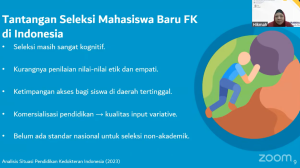
In her presentation, dr. Hikmah emphasized that medical school admissions in Indonesia remain heavily focused on cognitive and academic performance, with insufficient assessment of ethical values and empathy. This imbalance risks producing graduates who excel academically but may lack adequate readiness to navigate the complex human relationships inherent in clinical practice.

She also highlighted several critical challenges, including unequal access for students from 3T regions (Tertinggal, Terdepan, and Terluar – underdeveloped, frontier, and remote areas), the commercialization of medical education, and the absence of a national standard for non-academic assessment. As a comparison, dr. Hikmah discussed admission practices in countries such as the United States, the United Kingdom, and Canada, where selection processes have incorporated Multiple Mini Interviews (MMI), personality assessments, and evaluations of empathy and communication skills.

Towards the end of the session, several policy reform proposals were presented, including strengthening soft skills assessment, providing affirmative pathways for students from 3T regions, enhancing training for faculty interviewers, and involving professional organizations as well as bioethics experts in designing a fairer and future-oriented admissions system.

This topic is highly relevant within the framework of the Sustainable Development Goals (SDGs), particularly SDG 3: Good Health and Well-Being, SDG 4: Quality Education, and SDG 10: Reduced Inequalities. Reforming medical education admissions to be more inclusive, ethical, and equitable is a crucial foundation for ensuring that all citizens—without exception—have access to high-quality healthcare delivered by competent and principled medical professionals.

Reporter: Rafi 
Editor: Alvira
“Nrima”: A Javanese Cultural Value and Its Influence on Healthcare

BIOETIKA HUMANIORA MEDICAL ETHICS

Center for Bioethics and Medical Humanities (CBMH), Universitas Gadjah Mada, once again held its weekly routine program, Raboan Research and Perspective Sharing, on Wednesday, 30 July 2025. Conducted online via Zoom Meeting, the session addressed a highly relevant topic entitled “Nrima – a Particular Javanese Value and Its Impact on Healthcare.”
The event featured drg. Agnes Bhakti Pratiwi, MPH, Ph.D., a faculty member of FK-KMK UGM, as the main speaker, and was moderated by Ardhini Nugrahaeni, M.K.M.

The concept of nrima, which refers to sincere acceptance of one’s circumstances, including illness, is deeply rooted in Javanese society. This value reflects resilience, patience, and an adaptive capacity to face life’s challenges. In the healthcare context, nrima may encourage patients to remain steadfast and compliant during long-term treatment, while also supporting their mental well-being when dealing with chronic or irreversible conditions.

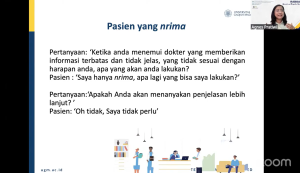
However, the discussion also highlighted the ethical challenges associated with nrima, particularly in relation to patient autonomy and doctor–patient communication. Patients who strongly adhere to nrima tend to be passive, less likely to fully express their symptoms, and reluctant to ask for further medical information. Consequently, healthcare providers may offer limited explanations, potentially reducing the quality and completeness of medical information received by patients.

“In the context of SDG 3: Good Health and Well-Being, it is crucial for healthcare systems not only to understand local cultural values such as nrima, but also to balance them with the fulfillment of patients’ rights,” stated drg. Agnes. She further emphasized, “Without culturally sensitive communication approaches, we may unintentionally diminish patient autonomy and weaken their participation in medical decision-making.”

Moreover, this phenomenon is closely related to SDG 10: Reduced Inequalities. Patients from certain cultural backgrounds, including Javanese communities that uphold nrima, face a higher risk of unequal access to comprehensive medical information and equitable involvement in healthcare decisions.

As potential solutions, drg. Agnes recommended strengthening education on patients’ rights, providing culturally sensitive communication training for healthcare professionals, and empowering patients to feel more confident in asking questions and expressing their needs. Through these efforts, healthcare services can become more inclusive, equitable, and effective.

This discussion represents an important contribution to CBMH’s ongoing commitment to promoting a locally rooted, globally respected approach—integrating local cultural values into the national healthcare system while upholding universal ethical principles.

Reporter: Ardhini Nugrahaeni, M.K.M
Editor: Rafi

Care Without Distance: Opportunities and Challenges of Telemedicine After the New Health Law

The Center for Bioethics and Medical Humanities (CBMH) at Universitas Gadjah Mada held another session of its weekly forum, Raboan Research and Perspective Sharing, on Wednesday, July 9, 2025. The discussion was conducted virtually via Zoom and explored a timely and important topic: “Telemedicine After the Enactment of Law No. 17 of 2023 on Health.” The session featured Dr. Febriyolla SK Sjaawalz, MH, CIIQA, lecturer at the Faculty of Medicine, UPN Veteran Jakarta, as the main speaker, and was moderated by NS Wahyu Dewi Sulistyarini, M.S.N.

In her presentation, Dr. Febriyolla explained how digital technology has significantly transformed the way healthcare services are delivered. One key example is telemedicine—remote healthcare services that use communication technologies. The COVID-19 pandemic accelerated the adoption of telemedicine, as both patients and healthcare providers needed a safe way to access and provide medical care during lockdowns and social restrictions.

Following the enactment of Law No. 17 of 2023, telemedicine in Indonesia now has a clearer legal foundation. This law officially recognizes telemedicine as part of the national health service system. It also mandates that telemedicine must be provided by licensed healthcare professionals through accredited healthcare facilities. Additionally, the law highlights the importance of maintaining high-quality service standards and ensuring the security and confidentiality of patient data.

During the session, participants were invited to explore the benefits of telemedicine, such as broader access to healthcare—especially for people in remote areas—and more efficient use of time and cost. However, Dr. Febriyolla also pointed out several challenges, including limited digital infrastructure, concerns about the accuracy of remote diagnoses, and the risks of data privacy breaches.

From both legal and ethical perspectives, telemedicine must still comply with existing regulations. Informed consent remains essential, and medical records must be securely stored. If malpractice or ethical violations occur, legal enforcement mechanisms continue to apply, just as they would in traditional clinical settings.

The topic closely aligns with several Sustainable Development Goals (SDGs), particularly SDG 3 (Good Health and Well-being), SDG 9 (Industry, Innovation, and Infrastructure), and SDG 10 (Reduced Inequalities). Telemedicine has the potential to reduce health disparities by providing more equitable access to care, even in hard-to-reach regions.

Through this Raboan event, CBMH UGM reaffirms its commitment to fostering interdisciplinary discussions that not only contribute to academic discourse but also address real-world issues that impact communities. Telemedicine is not just a technological tool—it represents a major shift in how we understand and provide healthcare in ways that are inclusive, secure, and just.

Reporter: Alvira Rahmasari, S.H.G.

Editor: Rafi Khairuna Wibisono, S.Kom.

[easy_youtube_gallery id=Bw1BkI_ePdU cols=1 ar=16_9 thumbnail=0 title=top]TELEMEDISIN PASCA UU NOMOR 17/2023 TENTANG KESEHATAN[/easy_youtube_gallery]

Hundreds of Ethnicities, Hundreds of Values: Exploring Indonesia’s Indigenous Bioethics

The Center for Bioethics and Medical Humanities (CBMH), Faculty of Medicine, Public Health, and Nursing, Universitas Gadjah Mada (FK-KMK UGM), held its regular Raboan Research and Perspective Sharing Forum on Wednesday, June 25, 2025. This session featured a compelling and timely topic: “Ethno-Bioethics for Indonesia”, with Prof. Dr. Heddy Shri Ahimsa-Putra, M.A., M.Phil., Professor of Anthropology at UGM’s Faculty of Cultural Sciences, as the keynote speaker. The discussion was moderated by Mahmasoni Masdar, S.Kep., Ns., M.Kep. from CBMH FK-KMK UGM.

In his presentation, Prof. Heddy emphasized that the development of global bioethics is still largely influenced by Western paradigms, which prioritize principles such as autonomy, beneficence, non-maleficence, and justice. While these principles are important, they may not align directly with the diverse cultural values, social structures, and worldviews of the Indonesian people. He called on scholars and policymakers to consider more contextual and culturally grounded approaches to bioethics. To that end, he introduced the concept of “Ethno-Bioethics”, an approach rooted in local cultural values, indigenous knowledge systems (ethnoscience), and traditional ethical frameworks held by Indonesia’s many ethnic groups.

“Indonesia is not a single nation but a collection of hundreds of ethnic groups, each with their own ways of understanding life, health, birth, and death,” Prof. Heddy stated.

He explained that over 600 ethnic groups in Indonesia possess distinct ethical systems and traditional knowledge related to life and health. Unfortunately, much of this wisdom remains undocumented, passed down only through oral traditions, and has yet to be integrated into academic discourse or national health policy. As examples, he cited the Javanese principle of kerukunan (harmony) and the Balinese teachings on the welfare of all living beings, both of which reflect universal bioethical values.

Prof. Heddy highlighted the urgency of conducting ethnographic research across Indonesia to collect, document, and revitalize these local ethical frameworks. He proposed the formulation of a distinctive “Indonesian Bioethics” or even a “Pancasila Bioethics” as Indonesia’s unique contribution to the global bioethics dialogue. He also encouraged UGM—through CBMH—to become a national pioneer in bioethics education, documentation, and advocacy that is culturally inclusive, contextually relevant, and rooted in justice.

This Raboan discussion aligns closely with the Sustainable Development Goals (SDGs). It supports SDG 3 (Good Health and Well-Being) by promoting culturally appropriate and widely accepted ethical approaches in healthcare. It also advances SDG 10 (Reduced Inequalities) by amplifying the voices and ethical knowledge of marginalized ethnic communities often overlooked in national policies. Furthermore, the call for interdisciplinary collaboration and ethnographic research fosters partnerships in line with SDG 17 (Partnerships for the Goals).

In closing, Prof. Heddy called for the national academic community to seriously pursue ethnographic bioethics research across regions and cultures to shape an inclusive, pluralistic, and culturally just bioethics framework—one that truly reflects the soul of Indonesia.

Reporter: Ardhini Nugrahaeni, M.K.M.

Editor: Alvira Rahmasari, S.H.G.

[easy_youtube_gallery id=0SBn4cNGgew cols=1 ar=16_9 thumbnail=0 title=top]Etnobioetika: Bioetika untuk/di Indonesia[/easy_youtube_gallery]

Bridging the Gap: Uncovering Health Inequities and Moving Forward

Yogyakarta, June 18, 2025 – Raboan Research and Perspective Sharing returned with a highly relevant and thought-provoking topic: “Ethics in the Distribution of Catastrophic Health Services under BPJS.”

This session featured expert speaker Prof. dr. Laksono Trisnantoro, M.Sc., Ph.D., Professor at the Department of Health Policy and Management, Faculty of Medicine, Public Health, and Nursing (FMPHN), Universitas Gadjah Mada. The discussion was moderated by Mahmasoni Masdar, S.Kep., Ns., M.Kep from CBMH UGM. Together, they explored the pressing issue of inequality in access to healthcare services across Indonesia.

Drawing from BPJS data from 2015 to 2023, Prof. Laksono presented how advanced medical procedures such as cardiac catheterization (Cathlab) remain concentrated in Java and Bali. In contrast, eastern regions like Papua and Maluku are significantly underserved. This disparity raises an ethical concern, as all BPJS members—regardless of their backgrounds—deserve equal access to life-saving health services.

Prof. Laksono also introduced ethical frameworks based on Pareto efficiency and Rawlsian justice in public policy, prompting reflection with questions such as: Is it justifiable that only a portion of the population benefits from state-of-the-art healthcare, while others lack even basic referral access? Is it ethical to allow a system to continue operating without addressing deeply rooted structural inequalities? As stated in the Pareto principle:

“A policy is considered good if at least one group becomes better off, without making others worse off.”

Raboan session was highly interactive, with participants from various professional backgrounds calling for true implementation of equity and social solidarity within the National Health Insurance (JKN) system.

This theme strongly aligns with the Sustainable Development Goals (SDGs), especially SDG 3: Good Health and Well-Being and SDG 10: Reduced Inequalities. Equal access to catastrophic health services is not merely about equipment or budgets—it is a matter of dignity and justice for all Indonesian citizens.

This Raboan discussion reaffirmed that equitable access to healthcare is not merely a matter of infrastructure and funding, but a question of justice and human dignity. It is hoped that this forum will serve as a concrete impetus for policymakers to build a more just, inclusive, and people-centered health system for all Indonesians.


[easy_youtube_gallery id=Iqs3kioSJR4 cols=1 ar=16_9 thumbnail=0 title=top]Etika dalam Pemerataan Pelayanan Kesehatan Katastropik BPJS[/easy_youtube_gallery]

“Posted First, Fired Later?” Learning from Healthcare Workers’ Social Media Cases: Ethics, Reputation, and Hospital Marketing

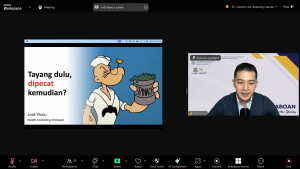
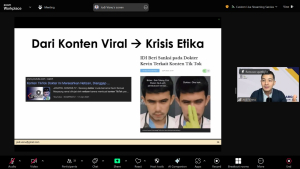
Yogyakarta, June 11, 2025 – The weekly Raboan Research and Perspective Sharing returned with a timely and relevant topic for the digital age: “Posted First, Fired Later? Learning from Healthcare Workers’ Social Media Cases: Ethics, Reputation, and Hospital Marketing.” The event was held online via Zoom, featuring dr. Jodi Visnu, MPH, a Health-Marketing Strategist, as the main speaker. The session was attended by a diverse audience, including healthcare workers, academics, hospital health promotion staff, and social media content creators. There was high engagement and active discussion, showing that this issue is a growing concern for both the healthcare world and the digital public.

Dr. Jodi explained how healthcare professionals today are not just caregivers, but also institutional influencers—meaning their social media posts can directly impact the reputation and public image of the hospitals they represent. Cases of viral content from medical staff leading to ethical controversies and even termination reveal a lack of proper digital communication policies in many health institutions.

He emphasized that while hospitals are encouraged to be more open and educational online, it’s important to differentiate between content that’s informative and helpful versus content made just to go viral. Ethics should not limit creativity—but guide it—ensuring responsible communication that respects others and doesn’t harm, especially patients. Dr. Jodi also highlighted the importance of instilling ethical awareness early in medical education and strengthening hospital policies to adapt to the digital era.

This session aligns with the spirit of the Sustainable Development Goals (SDGs), especially:

  • SDG 3 (Good Health and Well-Being): by promoting ethical and empathetic communication in healthcare to build trust, protect patients’ rights, and support a dignified, people-centered health system.
  • SDG 4 (Quality Education): by emphasizing the need for digital literacy and early ethics training for future health professionals.

This Raboan became a meaningful space for participants to critically reflect on the role of social media in shaping public perception. It reminded everyone that social platforms are not just tools for sharing content. They also carry real consequences for public trust, institutional reputation, and professional ethics in healthcare.

Reporter          : Alvira Rahmasari, S.H.G.

Editor              : Rafi Khairuna Wibisono, S.Kom.

[easy_youtube_gallery id=LReyJKcOpFI cols=1 ar=16_9 thumbnail=0 title=top]Learning from Healthcare Workers’ Social Media Cases: Ethics, Reputation, and Hospital Marketing[/easy_youtube_gallery]

Who Decides What Happens to Your Body? Raboan Talks About Family Roles in Medical Decisions During the Pandemic

Yogyakarta, June 4, 2025 – The weekly Raboan Research and Perspective Sharing returned on Wednesday with a meaningful discussion on real-life issues during the pandemic. Nathan Agwin Khenda, Ftr., M. Bio.Et., was the speaker, sharing insights on the topic: “Healthcare Workers’ Views on Family Involvement in Medical Decisions During the COVID-19 Pandemic.”

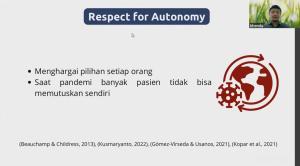
Khenda explained that during the pandemic, many patients couldn’t make decisions about their medical treatment. Some were too sick, didn’t understand their condition, or needed urgent care. So, decisions were often made by family members, community leaders, or even doctors directly.

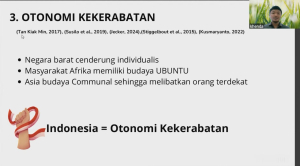
This shows how strong family and community culture is in Indonesia. Important decisions, especially in health, are often made together, not just by the patient alone. This is called “familial autonomy”, where families play a big part in choosing what happens in medical treatment.

Based on stories from two hospitals, Khenda shared how things like family relationships, cultural values, and emergency situations affect these decisions. In normal conditions, doctors will try to explain everything first to both patients and families. But in emergencies, they have to act fast to save lives.

“In crisis moments, doctors focus on doing what’s best for the patient (beneficence) and choosing actions with the least risk (minus mallum),” Khenda said.

This topic also connects to the Sustainable Development Goals (SDGs), especially Goal 3 (Good Health and Well-being) and Goal 16 (Justice and Strong Institutions). A good healthcare system should not only have good equipment or doctors, it should also respect people’s rights and cultural values.

This Raboan session left us with a big question to think about: in serious situations, who really makes the final call about our body—us, our family, or someone else?

Reporter          : Ardhini Nugrahaeni, M.K.M.

Editor              : Alvira Rahmasari, S.H.G.


[easy_youtube_gallery id=2PoxzM5xMQg cols=1 ar=16_9 thumbnail=0 title=top]Otonomi Kekerabatan dalam Pengambilan Keputusan Tindakan Medis saat Pandemi COVID-19[/easy_youtube_gallery]

Realizing a Safe and Healthy Hajj: Collaborating for Better Services

Yogyakarta, May 14, 2025 – Raboan Research and Perspective Sharing session held on Wednesday, May 14, 2025, with an engaging topic, “Health and Safety in Hajj: Strategies and Implementation.” The event featured drg. Lutfiah Sahabuddin, M.K.M., from the Faculty of Medicine, Universitas Alkhairaat, Palu, as the main speaker.

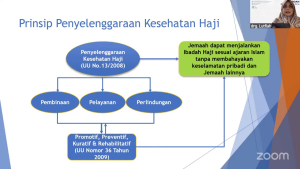
In her presentation, drg. Lutfiah emphasized the importance of health and safety strategies for Hajj pilgrims. According to the data presented, illnesses such as septic shock, cardiogenic shock, and acute myocardial infarction have been the leading causes of death among Hajj pilgrims in recent years.

Presentation session by drg. Lutfiah as speaker

discussion session with Raboan participant

“Hajj health management should prioritize promotive and preventive measures. Educating pilgrims from the preparation phase to the actual pilgrimage is key to reducing mortality rates,” stated drg. Lutfiah. She also highlighted the importance of teaching Hajj health to medical students, as has been implemented at the Faculty of Medicine, Universitas Alkhairaat, Palu, through a dedicated Hajj and Umrah module in their curriculum.

Furthermore, drg. Lutfiah discussed the ethical dilemmas often faced by Hajj healthcare professionals. One example is the case of elderly pilgrims who are not medically fit (istitha’ah) to perform Hajj, but their families refuse to accept this decision. To resolve such issues, the involvement of community leaders, healthcare teams, and the Ministry of Religious Affairs is crucial. These stakeholders must coordinate and deliberate to reach the best decision, ensuring that families understand and accept the outcome.

This discussion aligns with the commitment to achieving the Sustainable Development Goals (SDGs), particularly SDG 3 on good health and well-being. It is part of broader efforts to enhance public health literacy and improve the quality of Hajj healthcare services in Indonesia.

Through this discussion, Raboan Research and Perspective Sharing served as a valuable platform for exchanging knowledge and experiences related to the health of hajj pilgrims. It is hoped that this event will encourage improvements in hajj health services and strengthen collaboration among various stakeholders in addressing challenges on the ground. Ultimately, the goal is to ensure that Indonesian pilgrims can perform their pilgrimage in a safer, healthier, and more dignified manner.


[easy_youtube_gallery id=j-hP3fm2TJk cols=1 ar=16_9 thumbnail=0 title=top]Health and Safety in Hajj: Strategies and Implementation[/easy_youtube_gallery]

Is Childfree Ethically Justifiable? Raboan Discussion Forum by CBMH FK-KMK UGM Explores Childfree and Reproductive Choices

Speaker’s presentation

The Center for Bioethics and Medical Humanities (CBMH), Faculty of Medicine, Public Health, and Nursing, Universitas Gadjah Mada (FK-KMK UGM), held its regular Raboan Discussion Forum online via Zoom on Wednesday, May 7, 2025. This session brought up the topic “Childfree Movement: Philosophical Justification and Proposed Resolution,” featuring Albert Adiputra, S.Si., M.Sc., an alumnus of the Master of Bioethics Program at UGM, as the main speaker. The discussion was moderated by Mahmasoni Masdar, S.Kep., Ns., M.Kep., who is also active in the field of nursing and bioethics.

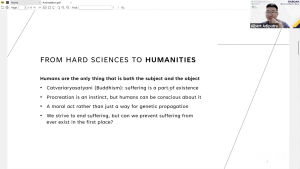
The topic was chosen in response to the growing number of people considering the decision not to have children—a concept known as childfree. In his presentation, Albert explained that such a decision may be influenced by various factors, including personal, economic, and environmental considerations, as well as individual values. The discussion also explored the philosophical concept of antinatalism, which encourages deeper reflection on the ethical dimensions of bringing new life into the world.

Discussion session with participant

Another aspect highlighted in the forum was the strong influence of cultural and social norms in many societies, including Indonesia, which often emphasize the expectation to have children. Social and familial pressure can make choices like childfree difficult to accept. This is why forums like Raboan are essential, as they create space for open dialogue and mutual understanding.

From the perspective of the Sustainable Development Goals (SDGs), this topic is relevant to SDG 3 (Good Health and Well-being) and SDG 5 (Gender Equality). Reproductive choices, including the decision to remain childfree, can be viewed through the lens of reproductive health rights, gender equality in decision-making, and awareness of ecological impacts linked to population growth.

The forum did not aim to promote or reject any particular stance but rather to help participants understand the complexity behind reproductive choices. By presenting a range of perspectives, the discussion encouraged a respectful culture of dialogue and a deeper appreciation of diverse values and life decisions within an evolving society.

Reporter: Alvira Rahmasari, S.H.G.
Editor: Rafi Khairuna Wibisono, S.Kom.

[easy_youtube_gallery id=4irpAQjul_o cols=1 ar=16_9 thumbnail=0 title=top]RABOAN “Childfree Movement: Philosophical Justifications and Proposed Resolutions”[/easy_youtube_gallery]

Communication Challenges in Interprofessional Collaboration in the Healthcare Sector

Wednesday, April 23, 2025 — Raboan Research and Perspective Sharing session was held with the theme “Communication Challenges in Interprofessional Collaboration (IPC) in the Healthcare Sector.” The event featured dr. Nasrun, S.H., M.Sc, an alumnus of the Master’s Program in Bioethics at UGM and currently a lecturer at the Department of Bioethics, Faculty of Medicine, Unisa Palu. The session was moderated by Ika Setyasari, S.Kep.Ns., M.N.Sc from CBMH UGM. More than 50 participants attended the event, including students, clinicians, and academics from various backgrounds.

BIOETIKA HUMANIORA MEDICAL ETHICS

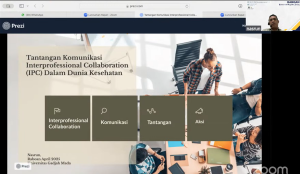
In his presentation, dr. Nasrun emphasized that the primary challenge in implementing IPC is cross-professional communication. IPC is crucial to support the shift from a paternalistic model of healthcare delivery toward a partnership model. It aims to improve the quality of care and optimize patient-centered care, positioning patients as the central focus in clinical decision-making.

Four main communication challenges in IPC include differences in meaning, professional ego, misaligned perceptions, and territorial boundaries between healthcare workers. Misunderstandings often arise, such as the use of the word “sorry,” which can be interpreted either as an admission of fault or, conversely, as an indication of incompetence. In emergency situations, these communication challenges become even more complex, requiring strategies like shared understanding and open interprofessional dialogue.

BIOETIKA HUMANIORA MEDICAL ETHICS

This topic aligns with Sustainable Development Goal (SDG) No. 3: Good Health and Well-being, which emphasizes the importance of a strong and responsive health system. It also relates to SDG No. 4: Quality Education, as effective IPC requires Interprofessional Education (IPE) to support the early development of collaborative competencies among healthcare professionals. Robust IPE programs will prepare health workers to communicate and collaborate effectively across professions.

[easy_youtube_gallery id=Wdge9LeTNYs cols=1 ar=16_9 thumbnail=0 title=top]RABOAN Discussion Forum 23 April 2025[/easy_youtube_gallery]

Reporter: Ika Setyasari, S.Kep.Ns., M.N.Sc

Editor: Rafi Khairuna Wibisono, S.Kom